


.jpg.rend.hgtvcom.126.196.suffix/1789013089131.jpeg)












5 Best Juicers of 2026, Tested and Reviewed
The best juicers can make getting your daily fruits and vegetables fast and easy.


Tested by Taylor Murray
We all know the importance of maintaining a diet high in fresh fruits and vegetables. The nutrients are undeniably important for health and wellness. The problem is that it isn't always easy to prepare and consume all the fruits and vegetables we actually need. It’s no wonder why juicing has taken off in popularity in recent decades. Imagine getting your total required daily servings of fruits and vegetables in a single glass of easy-to-drink juice. Whether you are already a juicing pro or just juice-curious, we've rounded up the best juicers after putting them through rigorous testing.
Our Top Juicer Picks


Taylor Murray
How We Tested
To find the best juicers, we analyzed the market for top sellers and highly rated favorites across the board. We selected several models of different types (slow, compact), sizes and price points.
Before any testing, we looked at each manual and instruction booklet to see which were clear and easy to follow or included helpful recipes. We noted how long it took to assemble each juicer and if there were any steps needed before juicing the first time. If any juicers made certain claims, we tested those to ensure that they did, in fact, deliver.
When it came to testing the main function (juicing), we ran three tests on each model. One whole apple (if a whole apple could fit in the hopper), three stalks of celery and one cup of leafy green kale. We noted which were easy to juice and which were not, as well as the noise level during juicing. We weighed the produce before testing, then weighed the pulp and measured the volume of juice to determine how much was extracted. Last, we cleaned each one to see how difficult or not they were to clean (and which were dishwasher-safe).

- Superior extraction
- Quiet
- Compact
- Foamy juice
Sometimes, bigger isn't always better. The NutriBullet Slow Juicer is also the most compact model we tested, so even the smallest kitchens can afford the countertop real estate needed to have a juicer set up and ready to juice at a moment's notice. The wide-mouth hopper can fit large items without having to pre-cut, like a whole apple. It has a lower noise level than other juicers and most of the parts are dishwasher-safe for quick cleanup.
During testing, the Nutribullet Slow Juicer won all our trials, hands down. Not only did it extract the most juice in every test, from tough kale to stringy celery, but did it more quietly than any other model. The juice nozzle comes with a convenient cap so the juice will not flow out until you are ready to catch it. Altogether, it's the perfect choice for daily, hassle-free juicing.
- Weight 11 pounds
- Dimensions 11.5" x 7.8" x 14.4"
- Style Masticating
- Power 150 watts

- Affordable
- Wide-mouth opening
- Easy assembly
- Noisy
- Bulky
- No juice container
Considering that most juicers on the market are well into the hundreds of dollars, it's amazing to find one that comes in under $100 and can still keep up with the pricier models. The Hamilton Beach Big Mouth Juicer arrives fully assembled for easy setup and features a wide mouth that can handle whole apples or several stalks of celery at once. It features a simple on/off switch for operation and has an extra-large pulp container. The lightweight design makes things easy when it comes to storage and setup. All parts and attachments are dishwasher-safe and easy to clean.
This budget pick didn't extract as much juice from hardier vegetables like kale due to a less powerful motor. The lighter weight also unfortunately means that the device tends to rattle a bit on the countertop and is noisier than other juicers. Aside from these issues, it's still a good lower-cost, no-fuss option.
- Weight 9 pounds
- Dimensions 11.5" x 7.8" x 14.4"
- Style Centrifugal
- Power 800 watts
- Heatless extraction
- Versatile operation
- dishwasher-safe
- Heavy
- Large size
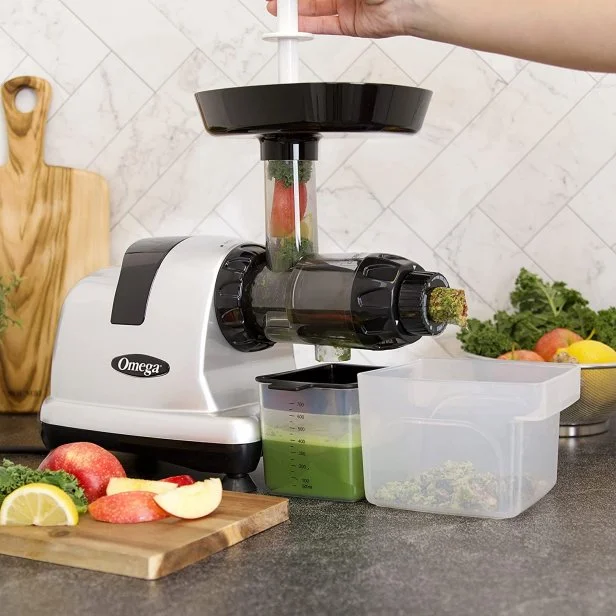
The Omega line of slow juicers has been a favorite among juice pros for decades. It has a horizontal slow-masticating auger that presses the juice out of fruits and vegetables without adding heat, which could kill nutrients. The heavy base won't jiggle or move on the counter. It includes parts to make pasta, breadsticks, nut butters and nut/soy milks, and it can make fruit and vegetable puree as well as juice.
While it tied with the Hurom we tested for the amount of juice extracted, the Omega was easier to clean (completely dishwasher-safe!), easier to put together and more versatile. You do have to cut produce down to fit in the narrow hopper tube but there's a handy food pusher included to help things move along.
- Weight 13 pounds
- Dimensions 14.5" x 6.5" x 15.5"
- Style Masticating
- Power 200 watts

- No assembly required
- Large food hopper
- Best possible juice extraction
- Pricey
- Lots of pieces
When it comes to centrifugal juicers, the Breville Cold Juice Fountain is the best choice. This gorgeous juicer has smooth, BPA-free plastic parts and a brushed chrome base with enough weight to keep it planted on the counter. Produce passes through the extra-wide food hopper before getting obliterated by the sharp teeth so the juice can pass through the micro-mesh sieve with minimal temperature transfer. Choose from two speeds to suit the type of produce being juiced, from the 6,500 RPM low-speed setting for soft fruit to the 13,000 RPM high-speed option for tough vegetables. It comes with a 70-ounce juice container that has a lid for easy storage and a 3.4-liter bin to catch all the pulp.
Of all the centrifugal juicers we tested, this one was able to extract the most juice from tough greens like kale and did well with apples and celery as well. Although a little bulky, this juicer arrived fully assembled and ready to go. We found it easy to clean with its dishwasher-safe parts that didn't require any scrubbing.
- Weight 11 pounds
- Dimensions 13.6" x 8" x 16.7"
- Style Centrifugal
- Power 850 watts

- Adjustable power level
- Dishwasher-safe parts
- Ultra-powerful motor
- Expensive
- Noisy
We already know that we like Breville's impressive line of powerful juicers, and this model is no different. Crafted with sleek brushed chrome and crystal clear plastic accessories, the Juice Fountain Pro XL is an improvement on all the other juicers from Breville in a variety of ways. It's designed to eviscerate even the toughest foods, extracting juice and leaving pulp behind with little heat transfer. The fully adjustable motor can rev up to 13,000 RPMs if needed, though the lower speeds should prove to be more than sufficient thanks to the razor sharp blades.
If you're looking for an upgrade on a standard centrifugal juicer, this model is designed for commercial use and will power through mounds of produce without wavering. The aesthetically pleasing parts are pretty enough to live on your counter full-time and made for easy cleaning in the dishwasher. While the motor can get a bit noisy during use, that's a small price to pay for top-tier performance.
- Weight 16 pounds
- Dimensions 7.9" x 15.7" x 19.7"
- Style Centrifugal
- Power 1200 watts

You can make delicious juice at home with the help of a juicer. Sarah Holden, culinary producer for Food Network Kitchen, demos three of our top picks, above.
Which Type of Juicer Is Best?
The process of juicing may seem simple, but different designs on the market have pros and cons on both sides. Most home juicers are either centrifugal or masticating.
Centrifugal juicers use a spinning blade-lined metal mesh basket to shred fruits and vegetables to pulp. Gravity pulls the juice down through the mesh and out to the juice cup, while centrifugal force whisks the pulp that's left behind up and over the side of the basket to the attached waste bucket. This type of juicer is fast and easy to use, and it generally needs fewer parts, making it easier to clean. Centrifugal juicers can come up short when juicing tough greens as the produce is not pressed against the screen long enough for much juice to be extracted and much of it ends up in the waste bucket. This type can also create oxidation in the juice which leads to more foam and separation.
Masticating juicers are sometimes also known as slow juicers. Some operate vertically and some horizontally, however, both work the same way. These types of juicers use an auger (a corkscrew-type part) to slowly mash produce against a strainer to separate the juice from the pulp. Produce cannot pass without being mashed by the auger, and for this reason, it can extract more juice from tougher produce. Many believe that slow or masticating juicers create less foam, heat and oxidation, therefore more nutrients are transferred to the juice and there is less waste. These types of juicers can take more time than a centrifugal juicer but ultimately produce more juice. One downside to this kind of juicer is that food that is not mashed small enough by the auger can become jammed inside, requiring the user to reverse the mechanism or take the entire juicer apart to clear. Another downside is that the food chutes for this type are often smaller and require food to be cut before inserting.

Taylor Murray
Which Type of Juicer Is the Healthiest?
All juicers create fresh-squeezed fruit and vegetable juice and there is no evidence to support that either type of juicer creates a substantially lower nutrient juice. Some heat may release certain types of vitamins, but most studies have conducted this test with temperatures upwards of 180 degrees F, which no juicer comes close to.
Masticating juicers can extract more juice and more juice means more nutrients. For this reason, masticating juicers may be considered ‘healthier’. However, some juice is better than no juice, so you should choose the juicer that works best for your lifestyle and budget.
How to Clean a Juicer
Many juicers have dishwasher-safe parts but some do not. The most important thing about cleaning a juicer is that fruits and vegetables contain moisture and sugar. If a juicer isn't cleaned right away, all the bits of pulp and sticky juice can make cleaning much more difficult. All the juicers we tested came with handy scrub brushes to help clean particles out of the fine mesh screens that filter the juice from the pulp.

How to Clean Your Juicer
Here are some best practices for keeping your juicer squeaky clean.
Why You Should Trust Our Tester
Taylor Murray is a graduate of Johnson and Wales University with a degree in Culinary Nutrition. She worked as a professional chef for over 10 years before moving into recipe and product testing and development. She has tested several hundred products for Food Network and other brands over the last six years, covering everything from carbon steel pans to food dehydrators.
Why You Should Trust Food Network Shopping Experts
Food Network Shopping Experts believe the best method for testing products is based on how our fans are going to use them in the real world. In each of our Tested and Reviewed stories, products are tested in real home kitchens that reflect real world use cases. Our testers follow rigorous testing rubrics designed by our expert editors and take copious notes during the testing process. When choosing the best products, our testers evaluate all of the testing data and take into consideration many factors including ease of use, price, product availability and practicality. The products covered on FoodNetwork.com are chosen completely independently by our editors without any outside influence. Our editors do not accept products in exchange for a positive review or promised coverage.